
Quick Read
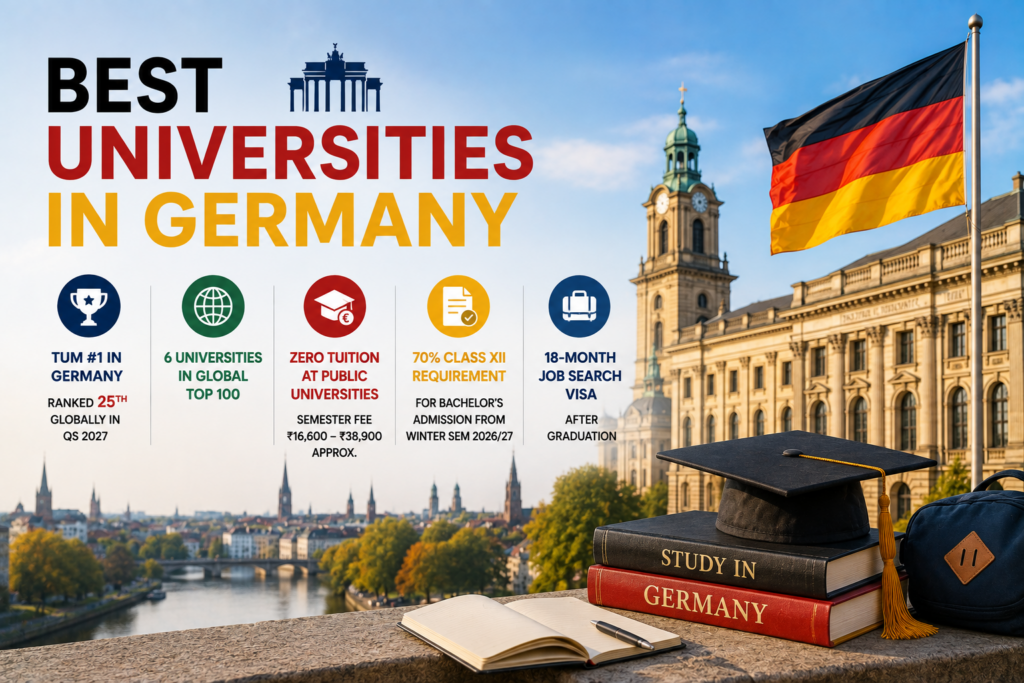
- Technical University of Munich is Germany’s top university, ranked 25th globally in QS 2027.
- 4 German universities sit inside the QS World University Rankings global top 100.
- Public universities charge zero tuition, only a semester fee of roughly Rs.16,600 to Rs.38,900.
- A new 70% Class XII rule applies to Bachelor’s admission from Winter Semester 2026/27.
- Graduates get an 18-month visa to search for a job after finishing their degree.
Top Universities in Germany Ranked by QS 2027
The QS World University Rankings released its 2027 edition in June 2026, and Germany had a strong showing: six universities inside the global top 100, more than most European countries manage. If you’re comparing the top 10 universities in Germany against each other, this is the most current, internationally recognized benchmark for finding the best universities in Germany.
| University | City | QS 2027 Rank |
|---|---|---|
| Technical University of Munich (TUM) | Munich | 25 |
| LMU Munich | Munich | 61 |
| Heidelberg University | Heidelberg | 86 |
| Freie Universität Berlin | Berlin | 98 |
| RWTH Aachen University | Aachen | 104 |
| Karlsruhe Institute of Technology (KIT) | Karlsruhe | 110 |
| Humboldt University of Berlin | Berlin | 140 |
| TU Berlin | Berlin | 158 |

Choose your dream country
 UK
UK
 USA
USA
 Germany
 Australia
 Ireland
 Canada
 UAE
UAE
 France
 Sweden
 Italy
Italy
 Other
Other
When do you want to study abroad?
What's your highest level of education?
Have you completed Class 12th?
What was your Class 12 CGPA/percentage?
Are you a student or a parent/guardian?
What do you want to study?
Select your current city
How Leap will help you

Personalised University Shortlist

Express Applications with Quicker Admits

End-to-End Application Support
TUM isn't just Germany's best university this year; it's the highest-ranked institution in the entire European Union, a position it's held for over a decade. Among the best universities in Germany, Munich and Berlin dominate this list, which is worth factoring in if city choice matters as much to you as the ranking itself.
My insight: A QS rank in the 100s doesn't mean a university is weak. Germany runs on a research-strength model where a school can rank modestly overall but lead the world in one specific field, which is exactly why the next section matters more for most applicants comparing top universities in Germany.
Top Universities in Germany by Subject: Bachelor's, Master's & PhD
A single global ranking doesn't tell you which of the best universities in Germany for international students is actually strong in your subject, and it definitely doesn't tell you at which degree level.
Germany's subject strengths hold across Bachelor's, Master's, and PhD programs alike, so the university-subject pairing below is useful whichever stage you're applying at.
This is the gap the DAAD's CHE ranking fills, since it surveys around 120,000 students and 3,000 professors subject by subject rather than producing one overall league table. Match your field to the school known for it and to the popular courses offered under it:
| Field | Popular Courses | Universities Known For It | Degree Levels |
|---|---|---|---|
| Engineering and Mechanical Sciences | Mechanical Engineering, Automotive Engineering, Robotics, Mechatronics | TUM, RWTH Aachen, KIT | Bachelor's, Master's, PhD |
| Medicine and Biosciences | Human Medicine, Molecular Biotechnology, Biochemistry | Heidelberg, LMU Munich | Bachelor's (Staatsexamen), Master's, PhD |
| Data Science and Informatics | Computer Science, Data Engineering, AI & Machine Learning | TUM, LMU Munich | Bachelor's, Master's, PhD |
| Social Sciences and Humanities | Political Science, Sociology, Philosophy | Humboldt Berlin, Freie Universität Berlin | Bachelor's, Master's, PhD |
| Business and Economics | International Management, Economics, Finance | LMU Munich, Mannheim, Humboldt Berlin | Bachelor's, Master's, PhD |
Picking by subject strength instead of the overall QS number is genuinely the smarter move for a Bachelor's, Master's, or PhD applicant weighing the best universities in Germany, since employers and research supervisors in your specific field usually know a program's reputation better than they know its global rank.
Cost of Studying at the Best Universities in Germany
Germany's biggest draw is still its tuition structure, and it's a genuine one, not a marketing line. Public universities across the list of public universities in Germany genuinely charge no tuition for international students outside Baden-Württemberg, which is the real reason this country keeps beating the UK and US on total cost despite offering some of the best universities in Germany at a fraction of the price.
| Category | Public Universities | Private Universities |
|---|---|---|
| Tuition Fees | Free (Baden-Württemberg charges non-EU students €1,500/semester) | €10,000 to €25,000/year (Rs.11.11 lakh to Rs.27.77 lakh) |
| Semester Fee | €150 to €350 (Rs.16,662 to Rs.38,878), usually includes a transit pass | €150 to €350 |
| Blocked Account (Sperrkonto) | €11,904/year (Rs.13.22 lakh), released at €992/month | Same requirement |
Source: DAAD: Costs of Education and Living in Germany
My insight: Students often budget the blocked account and stop there. Health insurance (roughly Rs.9,000 to Rs.12,000 a month) and the semester fee are separate, recurring costs that don't come out of the Sperrkonto, so build them into your monthly number from day one.
Eligibility: The APS Certificate and the New 70% Rule
Every Indian applicant needs an APS certificate before a German university or the visa office will even look at your file. Two updates landed in 2026 that most guides haven't caught yet.
| Requirement | Detail | India-Specific Note |
|---|---|---|
| APS Certificate | Verifies your academic documents are genuine | The fee is Rs.18,000, non-refundable, valid for life once issued |
| New 70% Rule (Bachelor's only) | Minimum 70% in Class XII, any board | Applies from Winter Semester 2026/27 onward; below 70% means no Bachelor's admission under current rules |
| dMAT Test (select Master's applicants) | Extra test for Engineering, Commerce, Finance, Economics, Business, or Management backgrounds | Applies from Summer Semester 2027 Master's intake onward |
| Language Proof | IELTS 6.5+ for English programs, TestDaF Level 4 for German-taught ones | GRE/GMAT still required for programs like TUM's Management & Technology |
According to APS India's own updates, the 70% threshold only affects Bachelor's applicants and doesn't touch Master's eligibility at the APS stage, so don't let that rule scare you off if you're targeting a Master's at one of the best universities in Germany for international students.
My insight: The dMAT catches people off guard because it's brand new. If your Bachelor's is in engineering, commerce, finance, economics, or management and you're applying for a Summer 2027 Master's intake or later, check the dMAT requirement before you assume your APS file is complete.
Scholarships for Studying at Best Universities in Germany
Zero tuition doesn't mean zero cost, and scholarships still matter for covering the blocked account and living expenses at even the best universities in Germany. Below are three university-specific options and two government-run programs open to Indian students, both merit-based rather than need-based.
| Scholarship | Type | What It Covers |
|---|---|---|
| DAAD Scholarship | Government (Federal) | Fully funded routes such as EPOS for Master's/PhD applicants with work experience cover stipend, insurance, and travel |
| Deutschlandstipendium | Government (Federal, co-funded with private sponsors) | €300/month merit-based award, open to all nationalities, for at least two semesters |
| TUM Scholarships | University-specific (TUM) | Merit and needs-based funding lines for international Bachelor's and Master's students |
| LMU International Office Study Scholarship | University-specific (LMU Munich) | Bavaria-state-funded award for international students and doctoral candidates showing academic excellence and financial need |
| Heidelberg University Scholarships | University-specific (Heidelberg) | Ruperto Carola scholarship programs supporting different stages of a student's degree |
For more details, our full scholarship guide for Germany breaks down eligibility and deadlines for each in more detail.
After Graduation: Job Seeker Visa and PR in Germany
Germany's post-study pathway is one of the more generous ones in Europe, and it's worth understanding before you commit to a university.
- 18-month job seeker visa. Graduates from any of the best universities in Germany get up to 18 months to find a job in any field while searching, not just their degree area.
Our Germany job seeker visa guide covers the application steps.
- EU Blue Card at €50,700. Land a job offer above this gross annual salary (Rs. 56.32 lakh), and you can skip straight to a Blue Card instead of the standard work visa. A reduced threshold of €45,934.20 applies for shortage occupations and recent graduates.
- Settlement permit timelines vary. Blue Card holders can apply for permanent residency in as little as 21 months with B1 German; standard work visa holders need longer.
Our Germany PR requirements guide lays out the full comparison.
Source: Make it in Germany: official government portal on working and residency in Germany
Planning Calendar for Your Upcoming Intake
Germany runs on two intakes a year. Winter Semester (1 October to 31 March) is the main one, carrying nearly every Bachelor's course and the widest spread of Master's programs. Summer Semester (1 April to 30 September) is smaller and offered by only some universities for select programs. Winter Semester 2026/27 applications (uni-assist deadline: 15 July 2026) have already closed, so Winter Semester 2027/28 is the next full-scale intake most students should plan around.
Month-by-Month Planning Calendar for Winter Semester 2027/28
| Timeframe | What to Do |
|---|---|
| Now – Dec 2026 | Shortlist universities, confirm exact program names, and check whether your field triggers the dMAT |
| Jan – Mar 2027 | Apply for your APS certificate early; standard processing is 3–4 weeks but can stretch to 8–10 weeks in peak season |
| Feb – Apr 2027 | Take IELTS/TestDaF, request transcripts, finalize GRE/GMAT if your program needs it |
| Apr – Jun 2027 | Submit applications via uni-assist or the university's own portal; some programs (RWTH, Stuttgart, select TUM Master's) close as early as May |
| 15 Jul 2027 | uni-assist's standard deadline for Winter Semester 2027/28 |
| Jul – Aug 2027 | Receive offers, open your blocked account, and immediately start your Consular Services Portal visa application |
| Aug – Sep 2027 | Attend your VFS visa appointment and arrange health insurance, accommodation, and travel |
| 1 Oct 2027 | Winter Semester 2027/28 begins |
For more details on student visas, read our guide on the German study visa here.
My insight: The date printed on a university's website is rarely the date that should drive your planning. APS processing and the VFS appointment queue are the two steps that most often blow past a comfortable timeline, and both are entirely outside the university's control. Start those two in parallel with your shortlisting, not after you've been admitted.
What to Do If You Don’t Meet the Requirements?
Class XII below 70%, applying for a Bachelor's: Under the current rules, this closes the standard pathway for Winter 2026/27 onward. Talk to a counselor about whether a foundation year or an alternate country makes more sense before you invest time in APS.
Your Bachelor's field triggers the dMAT, and you didn't know: Contact APS India directly to confirm your specific case before assuming your documents are complete. It's a recent enough change that even some university admissions offices are still catching up.
The QS rank feels too competitive for your profile: Acceptance rates vary a lot even among the best universities in Germany. TUM sits at roughly 8-15% depending on program, while several other strong technical universities accept considerably more. It's worth comparing actual admission odds, not just prestige, before you shortlist from the top 10 universities in Germany.
Key Takeaways on Best Universities in Germany
First, don't chase the QS number alone; match your subject to the university actually known for it, since Germany's strength is genuinely subject-specific rather than uniformly spread across every school.
Second, check where you land on the new APS rules immediately; the 70% threshold for Bachelor's and the dMAT for select Master's fields are recent enough that plenty of applicants are still finding out the hard way.
Third, budget beyond the blocked account since semester fees and health insurance are recurring costs the Sperrkonto doesn't cover.
Verified by: LeapScholar's Germany counseling team, with hands-on experience helping Indian students navigate APS certification, blocked accounts, and university shortlisting.
Have questions about which German university actually fits your profile? Book a free session with a LeapScholar counselor to map your subject and budget against the right shortlist.
Frequently Asked Questions About Best Universities in Germany
-
Which is the best university in Germany right now?
That's easily TUM. It holds the 25th spot globally in QS 2027, it's stayed at the top among German universities for over a decade, and it's also the highest-ranked university anywhere in the EU. If you're into engineering or tech, it's usually the first name your counselors and alumni will bring up.
-
Can I actually study for free at Germany's top universities?
Pretty much, yes. Public universities outside Baden-Württemberg charge zero tuition to international students. You'll still pay a semester fee, typically Rs.16,600 to Rs.38,900, but that's a fraction of what you'd spend elsewhere. The one exception is Baden-Württemberg, home to Heidelberg and KIT, which charges non-EU students around €1,500 a semester.
-
What's the difference between QS rankings and DAAD's CHE ranking?
QS gives you a single global number for each university. CHE, run by DAAD, goes subject by subject instead, based on surveys of actual students and professors. So if prestige is what you're after, look at QS. If you want the best fit for your specific subject, CHE will serve you better.
-
Do I need an APS certificate for a Master's degree too?
Yes, the APS certificate applies to Bachelor's and Master's applicants from India alike, regardless of degree level. The new 70% Class XII rule, though, only touches Bachelor's admission, so it won't affect you if you're applying for a Master's. Just keep an eye on the newer dMAT requirement, which can apply depending on what you studied earlier.
-
How much money do I need in my account for a German student visa?
You'll need €11,904 for the year, roughly Rs. 13.22 lakh at today's rate. This goes into a blocked account, and you don't get it all at once; it's released at €992 a month once you're in Germany. So plan your first month's expenses around that monthly cap rather than the full deposit sitting in your account.
-
Is IELTS mandatory for every German university?
For English-taught programs, generally yes, you'll need IELTS 6.5 or higher, though some universities will waive it if your entire previous degree was taught in English. German-taught programs ask for TestDaF or DSH instead, and a handful of competitive courses, like TUM's Management & Technology, also want a GMAT or GRE score.
-
How long can I stay in Germany after graduating to look for a job?
Up to 18 months, and during that time you can work in any field, not just something tied to your degree. That's a genuinely generous window compared to most of Europe, and it applies whether you graduated from TUM or a smaller regional university.
-
What's the dMAT test?
It's a new test APS India brought in for select Master's applicants, specifically those whose Bachelor's was in engineering, commerce, finance, economics, or business and management. It starts applying from the Summer Semester 2027 Master's intake, so if your intake is earlier than that, you likely don't need to worry about it yet.





Have Questions? Get Guidance to reach your Dream University
Connect with India's finest counsellors and biggest study abroad community.
Get Guidance