

Quick Read
- DAAD pays PhD scholars Rs.1,54,056 (€1,400) monthly as of 2026.
- Public university PhDs in Germany charge zero tuition fees.
- TUM ranks 25th globally in QS World Rankings 2027.
- Structured PhD programs have fixed deadlines; individual PhDs are rolling.
- German blocked accounts now require Rs.13,09,916 (€11,904) per year.
- APS certification usually takes 3 to 4 weeks to complete.
💬 What people are saying right now: About PhD in Germany for Indian Students
Why a PhD in Germany Indian Students Works in 2026
A PhD in Germany for Indian students is primarily a financial decision: public universities charge zero tuition, even at the doctoral level, which most other destinations cannot match. Germany’s PhD ecosystem is backed by DAAD funding, a QS 2027 ranking sheet with five German universities inside the global top 110, and a research culture built around the Max Planck Society, Fraunhofer Institutes, and Helmholtz Association.
- Tuition: Rs.0, at every public university, regardless of nationality
- Semester contribution: Rs.16,506 to Rs.38,514 (€150 to €350), covers student services and, in most states, a transit pass
- Funding backbone: DAAD, university-specific fellowships, and salaried research-assistant contracts
- Global standing: 5 German universities inside the QS World Rankings 2027 top 110
- Research network: Max Planck Society, Fraunhofer Institutes, Helmholtz Association, and DFG-funded Research Training Groups

Choose your dream country
 UK
UK
 USA
USA
 Germany
 Australia
 Ireland
 Canada
 UAE
UAE
 France
 Sweden
 Italy
Italy
 Other
Other
When do you want to study abroad?
What's your highest level of education?
Have you completed Class 12th?
What was your Class 12 CGPA/percentage?
Are you a student or a parent/guardian?
What do you want to study?
Select your current city
How Leap will help you

Personalised University Shortlist

Express Applications with Quicker Admits

End-to-End Application Support
That holds at every level. Describing the public system, a Mechanical Engineering graduate working in Germany since 2019 and contributor to LeapScholar's Germany guide, Mriganka Das, puts it plainly: "Public universities in Germany do not charge tuition fees, requiring only a nominal semester transport and administrative fee of around €200."
Counselor insight: Students who regret their PhD decision in Germany rarely regret the country. They regret picking a university based on the QS number alone instead of checking whether their specific research group had funding available for the year they wanted to start.
Structured vs. Individual PhD in Germany for Indian Students
Germany runs two parallel systems, and picking the wrong one wastes months.
| Individual Doctorate | Structured PhD Program | |
|---|---|---|
| How admission works | You find a professor (Doktorvater/Doktormutter) directly; no central portal | Central graduate school application, often interview-based |
| Best suited for | Applicants with a clear research proposal and a specific supervisor in mind | Applicants with a strong profile but a thinner publication record |
| Structure | Self-directed; you and your supervisor set the timeline | Fixed coursework, cohort, multiple supervisors |
| Typical route | Traditional and most common for Indian applicants | US-style doctoral school (DFG Research Training Groups, Max Planck Research Schools) |
| Deadlines | Rolling, no fixed date | Fixed intake windows, often December to March |
Counselor insight: Most Indian applicants default to individual doctorates because that is what shows up first in search results. But if your CGPA or research publication record is borderline, a structured program's interview-based admission often works in your favor, since a committee is evaluating potential rather than a single professor's inbox capacity.
Top Universities for a PhD in Germany for Indian Students
The QS World University Rankings 2027 confirm Germany's research strength has held steady, with the Technical University of Munich remaining the country's highest-ranked institution globally.
| University | QS Rank 2027 | Strong PhD Fields |
|---|---|---|
| Technical University of Munich (TUM) | #25 | Engineering, Computer Science, Physics |
| Ludwig Maximilian University of Munich (LMU) | #61 | Humanities, Physics, Psychology |
| Heidelberg University | #86 | Medicine, Chemistry, Life Sciences |
| Free University of Berlin | #98 | Political Science, Sociology, Humanities |
| RWTH Aachen University | #104 | Mechanical & Chemical Engineering |
| Karlsruhe Institute of Technology (KIT) | #110 | Electrical Engineering, Computer Science, Physics |
| Humboldt University of Berlin | #140 | Social Sciences, Physics, Economics |
| University of Tübingen | #230 | Medicine, Neuroscience, Theology |
| University of Freiburg | #245 | Biotechnology, Chemistry, Environmental Sciences |
| University of Göttingen | #261 | Physics, Biology, Agricultural Sciences |
Semester contribution across all ten: Rs.16,506–38,514 (€150–350). Exchange rate used: Rs.110.04 per Euro. Verify the current rate before finalizing your budget.
Note: PhD candidates in Germany are almost always exempt from the higher non-EU tuition that some states (like Baden-Württemberg) charge master's students, because doctoral researchers are frequently classified as university staff rather than as fee-paying students. Confirm this directly with your target university's official doctoral admissions page linked above, since classification varies by contract type.
Indian applicants concentrate on a narrow set of these. Two separately collected LeapScholar respondent pools — the main survey and a mentor sign-up sheet — both clustered around the same handful of universities: RWTH Aachen, TU Munich, TUHH, Stuttgart, and OVGU Magdeburg.
Eligibility and Exam Requirements for PhD in Germany for Indian Students
- Academic qualification: A Master's degree (or equivalent four-year Bachelor's with strong research experience in exceptional cases) in a relevant field
- CGPA benchmark: Minimum 7.5 out of 10 at most universities, though this varies by department and supervisor
- English-taught PhDs: IELTS 6.5 or TOEFL 90 iBT, the norm for most STEM programs. Check exact university-wise cutoffs on the IELTS score guide for Germany
- PTE-accepting programs: A smaller but growing number of universities also accept PTE; confirm your target university against the Germany PTE score requirement guide
- Duolingo-accepting programs: Check the current Duolingo-accepted universities in Germany list if you are relying on a Duolingo English Test score
- German-taught programs: TestDaF or DSH certification instead of an English test
- Research proposal: Should state your research question, proposed methodology, and why your target supervisor's lab specifically is the right fit. A generic proposal signals to a German professor that you have not done the homework
A well-structured SOP for PhD admission makes the difference between a reply and silence.
How your score reads to a German department is not a direct mapping. Germany converts your Indian percentage using the Modified Bavarian Formula, and because your pass mark sits in the calculation, an Indian 70% often lands as a competitive 2.0–2.4 on the German scale. A Master's graduate in Management from SRH Heidelberg and contributor to LeapScholar's Germany guide, Pooja Kale, saw this firsthand: "My Indian score of 8.98 CGPA converted to a 1.5 on the German grading scale. On the German grading scale, lower numbers are better; 1.0 is the best possible score, and 5.0 is a fail."
Documents Checklist for PhD in Germany for Indian Students
| Document | Purpose | India-Specific Detail |
|---|---|---|
| Master's degree certificate and transcripts | Proof of academic qualification | Must be attested; some universities also require a WES-style equivalency check |
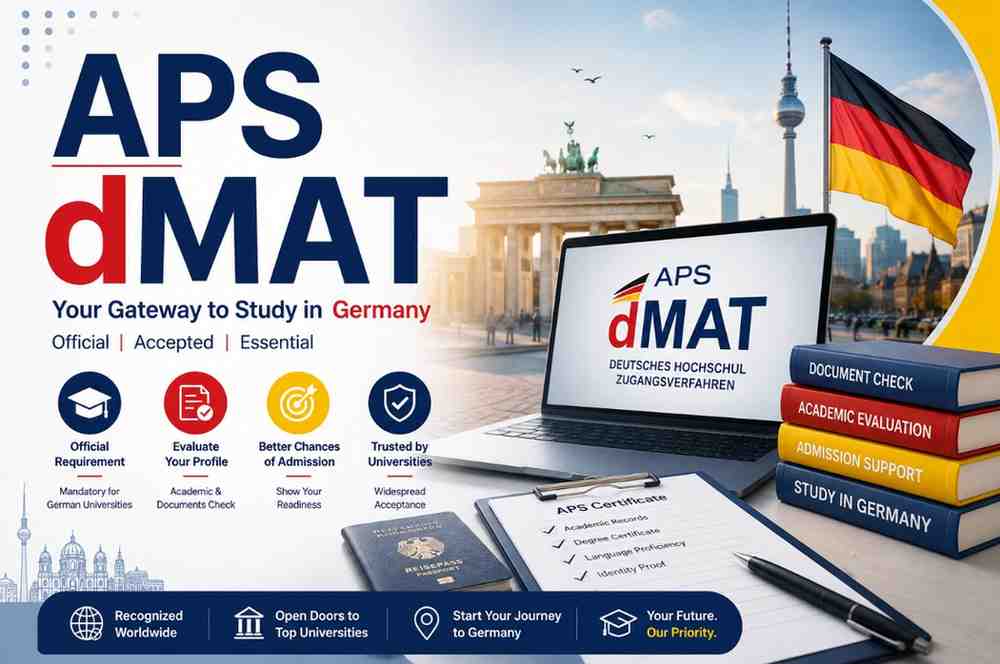
| APS Certificate | Verifies authenticity of Indian academic documents | Mandatory for all Indian applicants; processed through APS India |
| Research proposal | Core admission document for individual PhDs | Should name a specific professor and lab, not a general department |
| CV/academic resume | Summarises research and academic history | Include any publications, conference presentations, or thesis work from your Master's |
| Language proficiency proof | IELTS/TOEFL, PTE, or TestDaF/DSH | Score reports must be within the validity window most German universities set (usually 2 years) |
| Letters of recommendation (2) | Academic references | At least one should come from your Master's thesis guide, not just a subject professor |
| Passport copy and photographs | Visa and enrolment | Passport validity should extend at least 12 months past your intended start date |
| Proof of financial means | Visa requirement | Blocked account of Rs.13,09,916 (€11,904)/year, confirmed directly by the Federal Foreign Office, or a DAAD/scholarship letter as an alternative |
A Germany-recognized APS certificate is the single most commonly underestimated step in this checklist, since it cannot be rushed once submitted.
On what the account does if you are self-funding the first year: a Master's graduate from SRH Heidelberg and contributor to LeapScholar's Germany guide, Pooja Kale, explains, "A blocked account is a mandatory account where incoming international students deposit one year's worth of living expenses prior to arriving in Germany. It serves as financial proof for visa approval, releasing a fixed monthly amount to cover living costs."
Planning Calendar for PhD in Germany for Indian Students
Germany's academic year runs on two intakes. The winter semester (October to March) is the primary intake and the one most PhD positions, structured programs, and DAAD scholarship cycles align to.
| Month (Indian academic calendar) | Action |
|---|---|
| July to August (12 months before intake) | Finalize research area, shortlist 10 to 15 potential supervisors and structured programs. |
| September to October | Draft research proposal, request letters of recommendation, take IELTS/TOEFL/PTE if not already done |
| November to January | Begin direct supervisor outreach for individual PhDs; check structured program deadlines (many fall between December and March) |
| February to March | Submit DAAD scholarship application if pursuing external funding |
| April to June | Apply for APS certificate as soon as you have any positive signal from a supervisor or program. |
| May to July | University application deadlines for most Winter-intake programs |
| July to September | Visa appointment and blocked account setup once you have an admission or funding confirmation letter |
| October | Travel, register residence, and enrol at your German university |
A detailed breakdown of Winter intake deadlines in Germany is worth bookmarking, since exact dates shift by a few weeks each year.
Cost and Scholarships for PhD in Germany for Indian Students
The core appeal of a PhD in Germany for Indian students is that the degree itself costs almost nothing. Your real budgeting question is living costs and stipend coverage, not tuition.
| Funding source | Monthly amount | Annual/INR equivalent |
|---|---|---|
| DAAD PhD stipend | €1,400 | Rs.1,54,056/month |
| DAAD annual research allowance | N/A (annual, not monthly) | €460/year (Rs.50,618) |
| Blocked account (self-funded, visa proof) | €992 | Rs.13,09,916/year |
DAAD's official figure of €1,400/month supersedes older listings you may see elsewhere quoting €1,300.
On whether a stipend at that level actually covers a life in Germany, a Master's graduate in Management from SRH Heidelberg and contributor to LeapScholar's Germany guide, Pooja Kale, reports: "The monthly stipend was sufficient to cover my rent, health insurance, and basic monthly living expenses without needing financial support from my family."
Beyond DAAD, PhD candidates in Germany can genuinely access two other funding routes:
| Scholarship | Monthly Stipend | Duration | Key Eligibility |
|---|---|---|---|
| Studienstiftung des deutschen Volkes | €1,750 (includes €100 research allowance) + up to €100/month health insurance contribution | 2 years, renewable twice (up to 36 months total; 48 months with children) | Enrolled in a doctoral program at a German university; nationality irrelevant; last degree completed within the past 4 years |
| Heinrich Böll Foundation PhD scholarship | Amount not fixed by DAAD's official listing; third-party sources report a range of roughly €1,150–1,400/month, so treat any single figure as until confirmed directly with the Foundation | 2 years, extendable by up to 12 months | Admission to a doctoral program in Germany; German language proficiency at B2/DSH-2 level required; alignment with the Foundation's Green-political values (ecology, democracy, human rights) |
Note: the SBW Berlin Scholarship, sometimes listed alongside these, only funds Bachelor's and Master's study in Berlin or Potsdam and is not open to PhD candidates. It has been excluded here to avoid pointing you toward a route you cannot actually use for a doctorate.
A full comparison across PhD scholarships in Germany for Indians and a detailed PhD stipend breakdown can help you decide which to prioritize based on your field.
Exchange rate used: Rs.110.04 per Euro. Verify the current rate before finalising your budget.
City-level living costs vary meaningfully. Munich and Frankfurt run well above the DAAD stipend if you are not careful with rent, while cities like Aachen, Leipzig, or Göttingen are comfortably covered.
A closer look at the cost of living in Germany for Indian students breaks this down city by city.
Quick detour: From tuition-free master's programs to a €73,164 median salary and PR in 21 months, our complete Software Engineering in Germany guide maps the entire journey, fact-checked against Bitkom, BA Entgeltatlas, and German law.
Over a doctorate that gap compounds substantially. Having compared bases himself, a Process Engineer in North Germany and TU Bergakademie Freiberg graduate who contributed to LeapScholar's Germany guide, Hemanth Kiran, quantifies it: "Dresden versus Munich is roughly €300 to €400 a month, which adds up to €7,200 to €9,600 across a two-year Master's. That's the second-largest lever in this entire guide." Standard university towns typically run €600 to €700 a month, against €1,100 to €1,200 in Munich.
3 Takeaways on PhD in Germany for Indian Students
A PhD in Germany for Indian students is one of the strongest research-value degrees available globally, but three decisions determine whether the process goes smoothly.
- Confirm your pathway (structured vs. individual) before you start contacting professors, since it changes your entire application timeline.
- Budget Rs.1,54,056 per month if DAAD-funded, or plan for a blocked account of Rs.13,09,916 per year if you are self-funding your first year.
- Start supervisor outreach 10 to 12 months before your target winter intake, since APS certification alone can take a month and structured program deadlines cluster between December and March.
Verified by: LeapScholar's Germany counseling team, with hands-on experience guiding Indian students through PhD applications, DAAD funding, and the German student visa process.
Have questions about a PhD in Germany? Book a free session with a LeapScholar counselor.
Frequently Asked Questions About PhD in Germany for Indian Students
-
Is a PhD in Germany really free for Indian students?
In Germany, PhD programs at public universities do not have tuition fees, regardless of citizenship. You pay only a semester contribution of Rs.16,506 to Rs.38,514 (€150 to €350), which includes administrative costs and a public transport pass in most states. Some private universities and programs may charge fees, so check with your desired institution directly.
-
What is the DAAD Scholarship for PhD Students 2026?
PhD scholars are provided with a monthly stipend of Rs.1,54,056 (€1,400) and an annual research allowance of Rs.50,618 (€460) as well as health, accident, and personal liability insurance, according to the DAAD official scholarship database. This figure is specific to the DAAD Research Grants for Doctoral Candidates program; other DAAD programs may vary slightly.
-
What is the CGPA required for a PhD in Germany for Indian degree?
Most German universities require a minimum CGPA of 7.5 out of 10 from your master's degree. This varies depending on the department, program, and individual supervisor. Research experience and a good thesis are often more important than a small CGPA gap, particularly in the case of individual doctorates where the supervisor has the final say.
-
Do you need IELTS/TOEFL for PhD in Germany?
Most English-taught PhD programs require IELTS 6.5 or TOEFL 90 iBT, but requirements will vary depending on university and department. Some programs also take PTE or Duolingo scores, but these are fewer. Check the IELTS score guide for Germany against your target university’s exact cutoff before assuming any test is mandatory.
-
How to find a PhD supervisor in Germany from India?
You should first look at the DAAD PhD database, the Research in Germany portal and the individual university research group pages for professors working in your areas of interest.Instead of a generic inquiry, send them a specific research proposal, your CV, and a short note on why their lab is a good fit for your research goals.
-
Can I do PhD directly in Germany after BTech without a master's?
Some structured PhD programs or Max Planck Schools will accept excellent Bachelor's students with a four-year degree directly if you have conducted significant research work (e.g., a thesis or a publication).
-
What happens if my PhD supervisor in Germany doesn't respond?
Professors receive a high volume of cold emails and non-response is common, not necessarily a rejection. Send one polite follow-up after about three weeks, then move on to your next shortlisted supervisor rather than waiting indefinitely, since individual doctorate applications have no centralised deadline forcing urgency.
-
How long does APS certification take for a Germany PhD application?
APS certification for Indian students typically takes 3 to 4 weeks, though processing can extend during peak application season between April and July. Apply the moment you have any positive signal from a supervisor or program, since a formal admission letter is not required to start the APS process.
-
Can I get PR in Germany after completing my PhD?
PhD graduates can apply for an 18-month post-study job seeker visa immediately after submission of their thesis, which is the first real step toward permanent residency. After working in Germany for two years on an EU Blue Card, or five years on a standard work permit, permanent residency becomes achievable, and Germany's demand for skilled researchers generally supports a smoother transition than many other destinations.







Have Questions? Get Guidance to reach your Dream University
Connect with India's finest counsellors and biggest study abroad community.
Get Guidance