
Quick Read
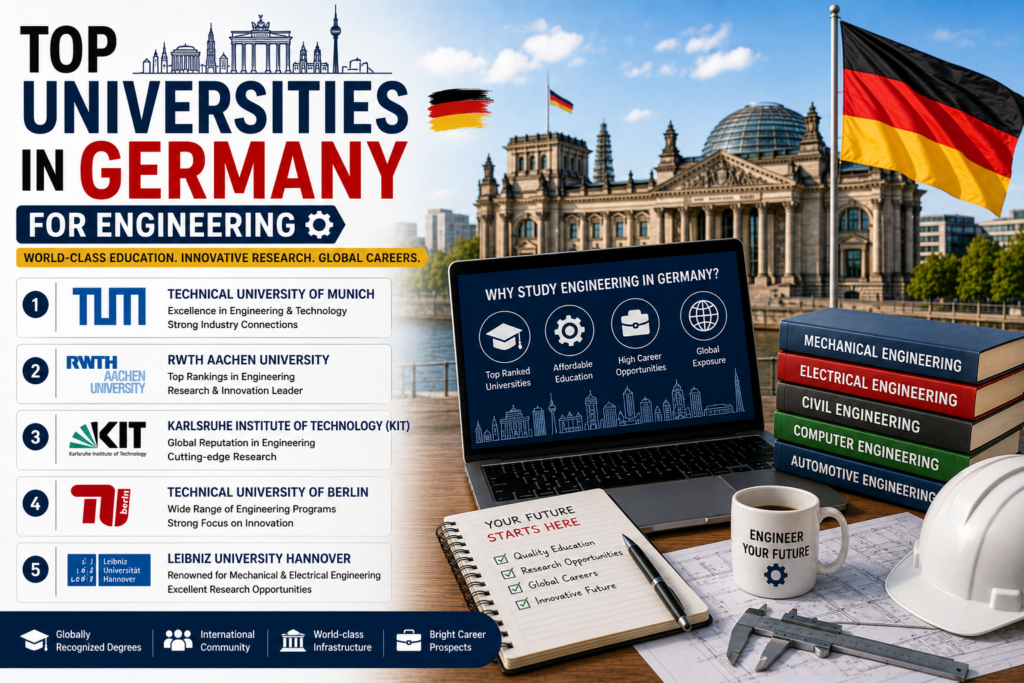
- TUM ranks #25 globally and #16 worldwide for Engineering & Technology (QS 2027 overall / QS Subject 2026).
- APS certificate now needs 70% or higher in Class 12, any board.
- Blocked account requirement is Rs.13.09 lakh (EUR 11,904) as of writing; recheck before transferring.
- Entry-level engineers start near Rs.42 to Rs.64 lakh a year, depending on specialization.
Top Universities in Germany for Engineering: QS 2027 Rankings and Fees
Germany’s TU9 group of technical universities anchors most shortlists for the top universities in Germany for engineering, and Indian students form one of the largest non-EU cohorts on these campuses. Most public universities charge Rs.0 tuition for the core degree; English-taught Master’s programs now run into the thousands, and recruiters like Siemens, Bosch, BMW, and Infineon hire directly out of the same labs where students train.
Three rule changes affect your 2027-28 shortlist. First, the APS certificate now requires a minimum of 70% in Class 12, any board, for Bachelor’s applicants, effective Winter Semester 2027-28. Second, Master’s applicants in engineering, commerce, and management must also clear a Digital Master Test (dMAT) from the Summer 2027 intake. Third, the blocked account requirement for 2026-27 is EUR 992 per month.

Choose your dream country
 UK
UK
 USA
USA
 Germany
 Australia
 Ireland
 Canada
 UAE
UAE
 France
 Sweden
 Italy
Italy
 Other
Other
When do you want to study abroad?
What's your highest level of education?
Have you completed Class 12th?
What was your Class 12 CGPA/percentage?
Are you a student or a parent/guardian?
What do you want to study?
Select your current city
How Leap will help you

Personalised University Shortlist

Express Applications with Quicker Admits

End-to-End Application Support
Counselor insight: Most students check the ranking table first and the eligibility rules last. That order costs an entire intake almost every winter cycle. Confirm your Class 12 percentage and APS eligibility before shortlisting a university.
Top Universities in Germany for Engineering: QS 2027 Rankings and Fees
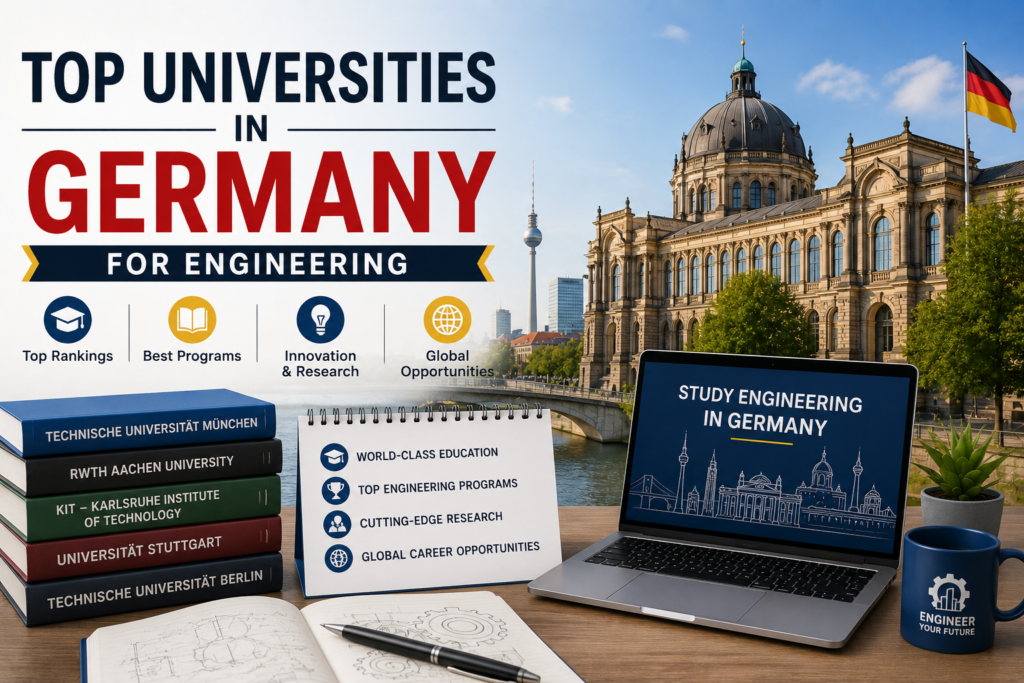
QS released its 2027 World University Rankings in June 2026, which is the current edition for your 2026-27 application. Most public universities remain tuition-free for the core degree; only Baden-Württemberg institutions (KIT, Stuttgart) and TUM charge a separate non-EU tuition component. RWTH Aachen has overtaken KIT in this edition: KIT ranked #98 to RWTH's #105 in QS 2026, and that order has now reversed to RWTH #104 ahead of KIT #110 in QS 2027, which is worth factoring into your shortlist.
| University | QS World Rank 2027 | QS Engineering & Technology Subject Rank | Strong Engineering Streams | Fee per Semester (Non-EU) |
| Technical University of Munich (TUM) | #25 | #16 | Aerospace, AI, Automotive, Robotics | Rs.2.2L to Rs.6.6L (EUR 2,000 to 6,000) |
| RWTH Aachen University | #104 | #53 (aggregate, all engineering fields) | Production, Automotive, Robotic Systems | Rs.0 (Rs.35,000 semester contribution) |
| Karlsruhe Institute of Technology (KIT) | #110 | - | Energy Systems, Mechanical, Informatics | Rs.1.65L (EUR 1,500) |
| Technical University of Berlin (TU Berlin) | #158 | - | Civil Systems, Computational Engineering | Rs.0 |
| TU Dresden | #185 | - | Microelectronics, Nano-tech | Rs.0 |
| TU Darmstadt | #250 | - | Electrical Engineering, Cybersecurity | Rs.0 |
| University of Stuttgart | #318 | - | Automotive, Process Engineering | Rs.1.65L (EUR 1,500) |
| Leibniz University Hannover | #470 | - | Mechatronics, Water Resources | Rs.0 |
| Hamburg University of Technology (TUHH) | #721-730 | - | Naval Architecture, Microelectronics | Rs.0 |
| TU Braunschweig | #781-790 | - | Aeronautical, Mobility Systems | Rs.0 |
Counselor insight: "Rs.0 tuition" is not "Rs.0 cost." Every university still charges a semester contribution of roughly Rs.25,000 to Rs.40,000 for student services and, in most states, a free regional transit pass.
- TUM: strongest in AI and automotive R&D; UnternehmerTUM feeds directly into Munich's startup and automotive cluster.
- RWTH Aachen: Germany's largest engineering faculty and deepest automotive/manufacturing employer network.
- KIT: merged university and Helmholtz research center; undergraduates get access to large-scale energy research infrastructure.
- TU Dresden: sits inside "Silicon Saxony," Europe's largest microelectronics cluster, with direct ties to GlobalFoundries and Infineon.
- University of Stuttgart: embedded in the Mercedes-Benz and Porsche supply chain; its ARENA2036 factory focuses on next-gen vehicle design.
A note on "acceptance rate": Germany's public universities don't publish a US-style admission percentage. Admission for most engineering programs is governed by Numerus Clausus (NC), a subject- and semester-specific cutoff based on your prior academic record, and, for some Master's programs, an internal selection process, not a fixed applicant-to-seat ratio. If a site quotes you a single "acceptance rate %" for TUM or RWTH, treat it as an estimate, not an official figure.
If applied-science institutes interest you too, see Universities of Applied Sciences in Germany for how the teaching style and admission bar differ.
Documents and Eligibility Checklist for Engineering Applicants
Before applying to the top universities in Germany for engineering, get your paperwork chain right. One missing document is the single biggest reason applications stall.
| Document | What It Confirms | India-Specific Detail |
| APS Certificate | Authenticity of Class 10, 12, and degree records | Mandatory since Nov 2022; now requires 70%+ in Class 12 for Bachelor's, effective Winter 2026-27 |
| English Proficiency Score | IELTS 6.0-6.5 or TOEFL iBT 80+ | TU9 universities generally accept IELTS Academic; some ask for TestDaF if the program has German-taught components |
| Blocked Account Confirmation | Financial capacity for one year | Rs.13.09 lakh (EUR 11,904) per Study.eu's 2026-27 blocked account guide |
| Health Insurance Proof | Statutory or private coverage from day one | Roughly Rs.12,000 to Rs.14,600 a month; arrange before enrollment |
| Uni-Assist or Direct Application | Formal application submission | Winter deadlines typically fall around July 15; some TU9 programs close earlier |
| Digital Master Test (dMAT), where applicable | Aptitude screening for select Master's applicants | Engineering, Commerce, and Management applicants, from Summer 2027 intake |
Counselor insight: Start APS the moment you decide on Germany, not after you have an offer. Processing can take 8-10 weeks during peak season, even though the standard turnaround is 3-4 weeks.
Not sure if you're tuition-exempt? Our counselors have answered this exact question for both Germany and Italy. For the visa stage itself, see how to get a Germany study visa for Indian students.
dMAT for Your MS/M.Tech in Germany: Does It Apply to Engineering Applicants for 2027-28?
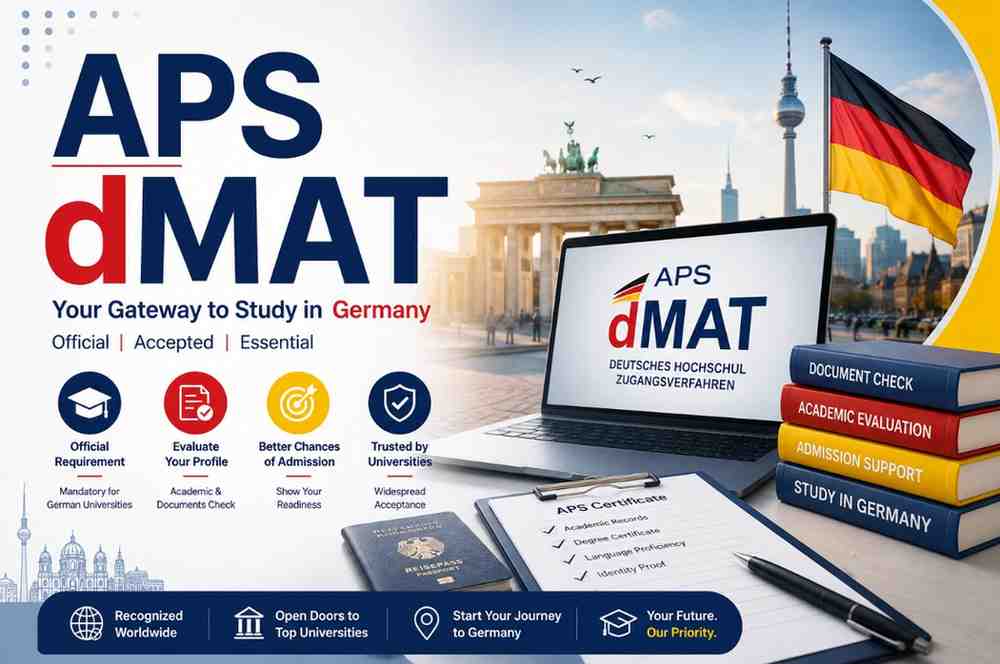
Since June 2026, a new document has entered the APS file for select Indian Master's applicants: the dMAT (Digital Master Test). It does not replace anything you have already budgeted for in this guide, but for students in specific fields it adds a fee, a deadline, and a planning step you need to account for, including if you're targeting the Winter 2027-28 intake, since the rule applies from Summer 2027 onward, not just to the first cycle.
| Requirement | Detail |
|---|---|
| Who needs it | Indian Master's applicants with an undergraduate degree in Engineering, Commerce, Accounting, Finance, Economics, or Business/Management |
| Who is exempt | Bachelor's, PhD, and exchange/double-degree applicants; students in fields outside the list above; anyone who completed APS online registration or shipped documents before 29 June 2026 |
| When it applies | Summer Semester 2027 intake and onward. This covers Winter 2027-28 and every intake after it |
| Exam fee | Rs.16,500 (EUR 150), paid directly to g.a.s.t. and separate from your APS fee |
| Test cycles so far | Only one confirmed cycle to date: registration closed 15 September 2026, exam held 26 September 2026, results released 12 October 2026. No second test date has been officially announced yet; check aps-india.de and d-mat.de directly before assuming a schedule. |
| Format | Two modules across roughly 3.5 hours: a Core Module (reasoning) and a Subject Module. Single-choice questions, no negative marking |
| Does it replace APS? | No. It is an additional document inside your APS file, not a substitute for APS verification |
If you are a final-year BTech, BE, or BCom student following the Winter 2026 timeline in this guide, the dMAT does not affect you. It only becomes relevant once you shift your target to Summer Semester 2027 or later, and only if your undergraduate field is on APS India's affected list.
For students it does apply to; the practical cost impact is straightforward: add Rs.16,500 (€150) to your one-time pre-departure costs, on top of the Rs.1.06L-Rs.1.56L already listed in the cost table above, and register before the g.a.s.t. deadline so the dMAT certificate is ready before you file your APS documents.
Counselor insight: Most Computer Science, Data Science, and Life Sciences applicants do not fall under the affected fields list yet. If your undergraduate program is interdisciplinary, such as Business Analytics, Industrial Engineering, or FinTech, don't assume you are exempt. Check your classification against APS India's official affected-fields list before you skip the dMAT registration window.
Which of the Top Universities in Germany for Engineering Fits Your Profile?
Rankings tell you prestige, not fit. Use these scenarios to narrow your shortlist among the top universities in Germany for engineering before spending on APS and application fees.
Final-year BTech, graduating May 2027, targeting Mechanical/Automotive: anchor your shortlist around TUM, RWTH Aachen, and University of Stuttgart. File APS by January 2027 so it's ready before the July 15, 2027-28 winter deadline.
Class 12 student with a strong JEE Advanced score, aiming for direct-entry Bachelor's: a competitive JEE rank can sometimes help you skip the one-year Studienkolleg, but this is assessed case by case. Confirm with the specific university's international office.
Working professional, 2-3 years' experience, targeting Data Science/Robotics/Industrial Engineering for an EU Blue Card later: KIT, TU Berlin, and TU Darmstadt carry stronger industry-linked thesis placements that convert more directly into post-study offers.
Counselor insight: Students who convert offers into visas fastest pick two or three universities with overlapping windows, not ten with conflicting deadlines. Depth beats breadth here.
When to Apply For Top Universities in Germany For Engineering
The Winter 2026-27 window has closed; you are now planning for Winter 2027-28. Start your APS certificate as soon as you commit to Germany, and expect most Winter deadlines to fall around mid-July, based on the pattern of the last several cycles, confirm the exact 2027-28 date on each university's own admissions page once it is published, since German universities typically release the following year's exact deadlines 6-9 months in advance.
For the full month-by-month breakdown mapped to the Indian academic year, see our Winter Intake in Germany guide.
Far fewer TU9 engineering programs run a Summer intake, so confirm your shortlisted university actually offers one before planning around it. A well-timed Statement of Purpose for Germany is often the difference at a TU9 university, so budget three weeks for drafts.
Cost of Studying at Top Universities in Germany for Engineering
Budgeting for the top universities in Germany for engineering has three layers: semester fees, living expenses, and the blocked account.
| Cost Head | Annual Amount |
| Semester fee (TUM/KIT/Stuttgart only) | Rs.0 to Rs.13.2L (EUR 0 to 6,000) |
| Semester contribution (all universities) | Rs.25,000 to Rs.60,000 |
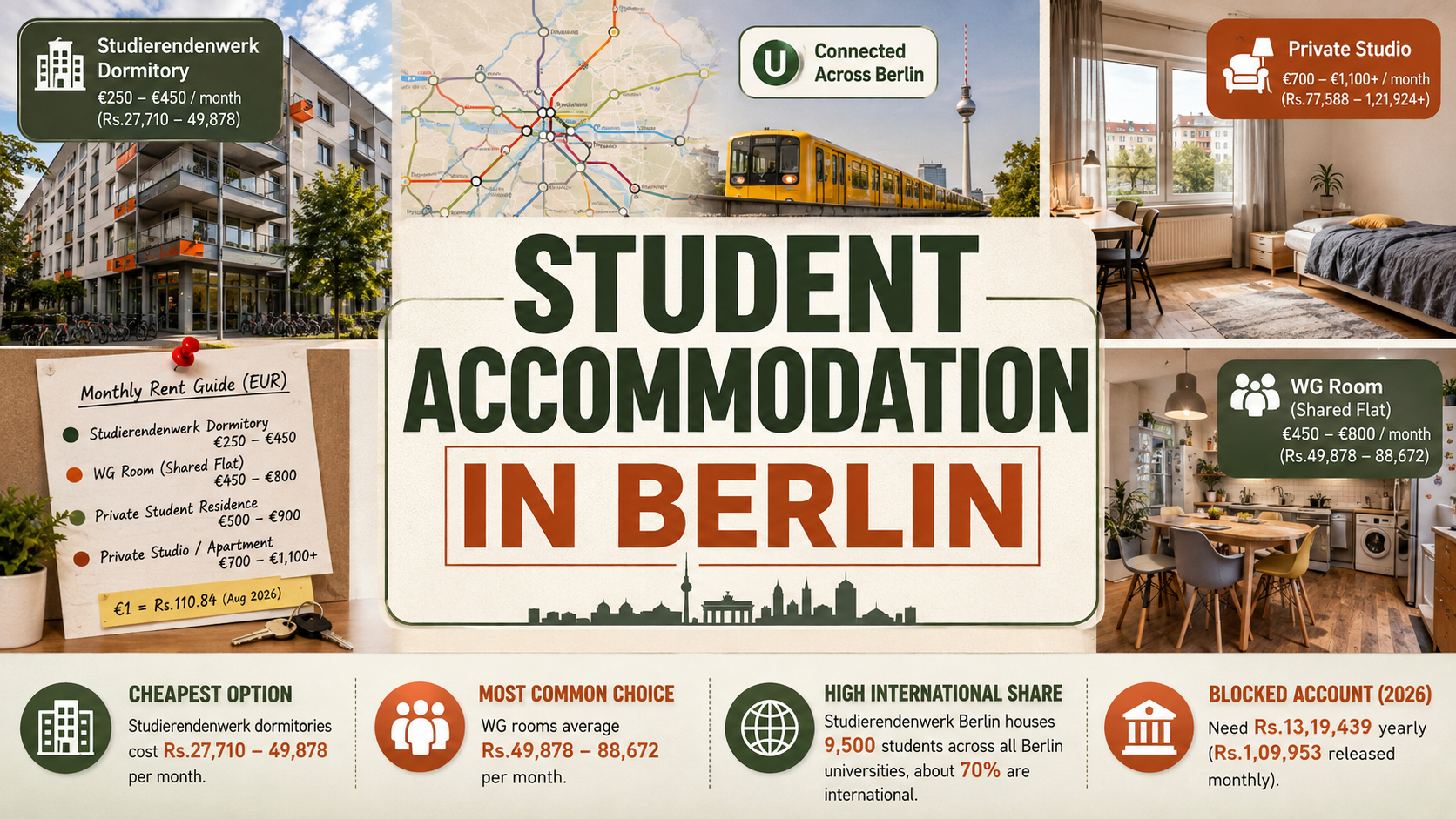
| Blocked account (2026-27 requirement) | Rs.13.09L (EUR 11,904) |
| Health insurance | Rs.1.43L to Rs.1.76L (EUR 1,300 to 1,600) |
| Accommodation (shared, mid-size city) | Rs.3.96L to Rs.6.6L (EUR 3,600 to 6,000) |
Counselor insight: Families often size their loan around the blocked account figure alone, which covers living expenses only. If admitted to TUM or KIT, budget the semester fee separately.
Wondering how this stacks up against other countries? Our counselors compare living costs and lock-in amounts for German public universities here.
Salaries and Career Pathways After Top Universities in Germany for Engineering
Graduating from one of the top universities in Germany for engineering opens two practical routes: the 18-month job-seeker extension or a direct move to the EU Blue Card with a qualifying offer.
| Role | Average Annual Salary | Entry-Level Range |
| Mechanical Engineer | Rs.68.2L (EUR 62,000) | Rs.55L to Rs.63.8L (EUR 50,000-58,000) |
| Software Engineer | Rs.63.8L (EUR 58,000) | Rs.48.4L to Rs.57.2L (EUR 44,000-52,000) |
| Electrical Engineer | Rs.61.6L (EUR 56,000) | Rs.44L to Rs.52.8L (EUR 40,000-48,000) |
| Civil Engineer | Rs.57.2L (EUR 52,000) | Rs.41.8L to Rs.46.2L (EUR 38,000-42,000) |
Entry-level Mechanical Engineering figures are aligned with our Masters in Mechanical Engineering in Germany guide, which cites Rs.55L-Rs.63.8L (EUR 50,000-58,000) for Graduate/Junior Engineers with 0-2 years' experience.
As of January 1, 2026, the standard EU Blue Card salary threshold is EUR 50,700 gross annually (roughly Rs.55.8L). Shortage occupations, including engineering, qualify at a reduced EUR 45,934.20 (roughly Rs.50.5L). Germany revises this threshold every January; the 2027 figure had not been published at the time of writing, so re-check the Federal Government's Make it in Germany page before you rely on this number for a job offer in 2027.
Get PR in 21 months with the EU Blue Card, no lottery required. Read more about it in our exhaustive guide for Software Engineering in Germany.
Counselor insight: Salary bands barely shift between TU9 universities. What actually moves your starting offer is your thesis company and city; Munich and Stuttgart pay 10-15% above the national average, just on cost-of-living adjustments alone.
Curious if your post-study work visa is guaranteed? Our counselors confirm the 18-month rule here. For a wider role comparison, see Highest Paying Jobs in Germany for Indians.
3 Takeaways on Top Universities in Germany for Engineering
- Start your APS certificate the moment you decide on Germany, not after you have an offer. The 70% Class 12 rule and 3-to-8-week processing window mean late starters lose an entire intake, and for Winter 2027-28 Master's applicants in engineering, the dMAT adds one more step to plan around.
- Match your profile to a university's actual research strength, not its rank alone. TUM, RWTH Aachen, KIT, TU Dresden, and Stuttgart each lead in a different engineering domain, and TUM's #16 global rank specifically for Engineering & Technology matters more for your program choice than its #25 overall rank.
- Budget the blocked account and semester fees as two separate line items. Rs.13.09 lakh covers living costs only; TUM and Baden-Württemberg universities charge tuition on top of that.
Have questions about applying to Germany's top engineering universities? Book a free session with a LeapScholar counselor.
Frequently Asked Questions About Top Universities in Germany for Engineering
-
Is JEE accepted in Germany?
No, JEE is not an official admission requirement for German universities. A good score in JEE Advanced can sometimes allow you to skip the one year Studienkolleg and get directly into Bachelor’s, although this is decided on a case by case basis.
-
What are the top 3 universities in Germany for engineering?
According to the QS 2027 ranking, the top 3 universities are Technical University of Munich (#25), RWTH Aachen University (#104), and Karlsruhe Institute of Technology (#110). If you're comparing by engineering-specific research strength rather than overall rank, TUM's QS Engineering & Technology subject rank (#16) is the more relevant number.
-
Can I get a job in Germany after BTech?
Yes, but it's easier with a German Master's or B1-level German. Most Indian BTech graduates strengthen their job prospects by first completing an MS at a TU9 university, which also unlocks the 18-month job-seeker visa.
-
Which engineer is most in demand in Germany?
Software and IT engineers are most wanted thanks to the digital and AI push in Germany, followed by mechanical and electrical engineers, linked to the automotive and energy industries. All three meet the lower requirement for an EU Blue Card shortage occupation.
-
Is it better to study in India or Germany?
It depends on your goals. In Germany, you can study engineering at globally recognized TU9 universities for free and get an EU Blue Card. Germany has a lower total cost and does not require relocation to India. If you want global exposure and post-study work, choose Germany.
-
What are the top public universities in Germany for engineering?
Almost all TU9 universities are state-funded. The best public institutions in Germany for engineering are TUM, RWTH Aachen, KIT, TU Berlin, and TU Dresden, and most charge Rs.0 tuition for the core degree.
-
Which German universities offer engineering programs in English?
TUM, RWTH Aachen, KIT, TU Berlin, TU Dresden, and TU Darmstadt all offer English-taught Master's programs in engineering. Fully English-taught Bachelor's programs are rare and usually require Studienkolleg first.
-
What is the average starting salary after graduating from a top engineering university in Germany?
Entry-level pay is often between Rs.44L and Rs.57L a year (EUR 40,000-52,000), depending on specialization and city. Software and data roles are on the upper side.
-
How long can I stay in Germany after graduation to find a job?
Graduates can apply for an 18-month job-seeker residence permit. Once you secure a qualifying offer, you transition to a work permit or the EU Blue Card.
-
Do I need a blocked account if I already have a DAAD scholarship?
Some fully funded scholarships, including select DAAD grants, can replace the blocked account requirement if they cover your full living expenses. Confirm with your visa-issuing mission. See our DAAD Scholarship Germany guide for which ones qualify.
-
Do I need to pay for the dMAT exam separately from APS?
Yes, the dMAT fee is separate from your APS fee. It costs Rs.16,500 (€150), paid directly to g.a.s.t. at registration, not to APS India. Your APS fee of Rs.18,000 still applies on top of the dMAT fee if the dMAT requirement affects you. Budget for both as separate line items in your pre-departure costs.
-
Does the dMAT apply to my MS in Germany intake?
It depends on your intake and your undergraduate field. The dMAT applies from the Summer Semester 2027 intake onward; this includes Winter 2027-28 and every intake after it, not just the first cycle. Even then, it only applies if your bachelor's degree is in Engineering, Commerce, Accounting, Finance, Economics, or Business/Management. Check APS India's affected-fields list to confirm your case.







Have Questions? Get Guidance to reach your Dream University
Connect with India's finest counsellors and biggest study abroad community.
Get Guidance