
Quick Read
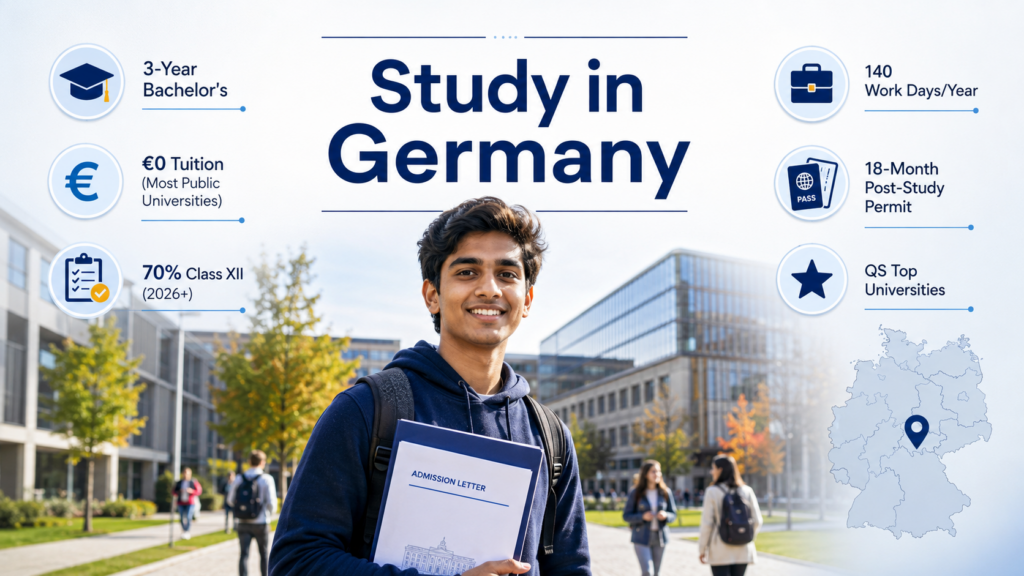
- Public universities charge no tuition, only a semester fee.
- TUM and Baden-Wurttemberg schools charge separate master’s fees.
- Blocked account: Rs.12,96,584 (€11,904) per year for 2026.
- Master’s applicants in select streams need dMAT from Summer 2027.
Why Do Indian Students Study in Germany?
Germany draws Indian students for one reason above all others: you get a globally ranked degree without the debt that usually comes with studying abroad.
- Near-zero public tuition, with only a semester fee at most universities in Germany.
- Globally ranked universities, with six German institutions in the QS World University Rankings 2027 global top 110.
- A structured German student visa and APS process built specifically for Indian applicants.
- Three distinct entry paths: Bachelor’s, Master’s, and Ausbildung (paid vocational training).
- A genuine post-study runway, including an 18-month job-seeker permit and a clear route to permanent residency in Germany.

Choose your dream country
 UK
UK
 USA
USA
 Germany
 Australia
 Ireland
 Canada
 UAE
UAE
 France
 Sweden
 Italy
Italy
 Other
Other
When do you want to study abroad?
What's your highest level of education?
What do you want to study?
Select your current city
How Leap will help you

Personalised University Shortlist

Express Applications with Quicker Admits

End-to-End Application Support
Here's how the top German universities stack up in the QS World University Rankings 2027:
| University | QS 2027 Rank |
| TUM (Technical University of Munich) | #25 globally, highest-ranked in the EU |
| LMU Munich | #61 |
| Heidelberg University | #86 |
| Freie Universitat Berlin | #98 |
| RWTH Aachen | #104 |
| KIT | #110 |
My insight: Students who shortlist by QS rank alone often miss that fee structures now differ sharply between universities in Germany for international students. Rank the university and its tuition policy together, not separately.
Bachelor’s, Master’s, or Ausbildung: Which Path Fits You
Not every student needs a full degree to build a career in Germany. Whether you're weighing a Bachelor’s, Master’s in Germany, or a vocational route, here's how the three main paths to study in Germany compare:
| Path | Duration | Typical Cost (Public) | German Needed | Outcome |
| Bachelor's | 3-4 years | Semester fee only: EUR 150-430 (Rs.16,338-Rs.46,836)/semester | Often B2 for German-taught courses | Entry-level roles or further study |
| Masters in Germany | 1.5-2 years | Semester fee, or EUR 4,000-6,000 (Rs.4,35,680-Rs.6,53,520)/semester at select universities | Optional for English-taught programs | Skilled job market, EU Blue Card eligibility |
| Ausbildung courses in Germany | 2-3.5 years | No fees; legal minimum trainee pay EUR 724/month (Rs.78,858) in year 1 of 2026, rising each year | Usually A2-B1 German required | Direct employment, faster PR pathway |
Exchange rate used throughout this article: EUR 1 = Rs.108.92 as of July 2026. Rates change daily; recheck before finalizing your budget.
If you're a Class 12 pass-out eyeing the Bachelor's route, check your eligibility first. A standard Indian Class 12 certificate (CBSE, ICSE, or state board) isn't treated as equivalent to the German Abitur, so most applicants need one of three things before they can enrol directly, per DAAD India's official Bachelor's studies page:
- A one-year Studienkolleg (foundation course) followed by the Feststellungsprufung (FSP) exam, or
- One completed year at a recognised Indian university, or
- A valid JEE Advanced result, which exempts you from Studienkolleg at several technical universities
My insight: Ausbildung suits working professionals who want income from day one, not a research-heavy degree. Don't default to a master's just because it's the familiar option. If you're unsure whether your Bachelor's profile is strong enough for a Master's admit without a GRE score, see what our counselors say about GRE requirements for a Master’s in Germany.
Study in Germany for Free: What “Tuition-Free” Really Means
Most public universities in Germany genuinely charge no tuition, only a semester contribution of EUR 150-430 (Rs.16,338-Rs.46,836) that covers administration and often a transport pass. But "study in Germany for free" comes with two real exceptions worth budgeting around:
- TUM (Technical University of Munich): Non-EU students enrolling from Winter Semester 2024/25 pay EUR 2,000-3,000 (Rs.2,17,840-Rs.3,26,760)/semester for Bachelor's and EUR 4,000-6,000 (Rs.4,35,680-Rs.6,53,520)/semester for Master's, confirmed on TUM's official tuition page.
A handful of programs, including Software Engineering and Quantum Science and Technology, remain fee-free even at TUM.
- Baden-Wurttemberg universities (including Heidelberg University): Non-EU/EEA students pay EUR 1,500 (Rs.1,63,380)/semester for Bachelor's and consecutive Master's programs, per Heidelberg University's own fee page.
Counselor insight: Always check the specific program page before assuming zero tuition. TUM's exceptions are program-specific, not university-wide.
The dMAT Requirement Every 2027 Master’s Applicant Must Check
From Summer Semester 2027, the digital Master Test (dMAT) becomes a mandatory part of your APS documentation if your bachelor's degree is in engineering (including computer science and IT), commerce, accounting, finance, economics, business, or management. Here's what changes and who it actually affects:
- Applies only to master's applicants targeting Summer Semester 2027 or later. Winter Semester 2026/27 applicants are not affected by this change.
- Costs EUR 150 (Rs. 16,338), run by g.a.s.t., the organization also responsible for TestAS, as confirmed on the official dMAT information page.
- The first certificates will be issued starting 12 October 2026.
- A low dMAT score does not fail your APS certification. It's an additional document, not a replacement for APS verification.
- Bachelor's and PhD applicants are exempt regardless of stream.
My insight: Don't wait for your final semester results to check whether the dMAT applies to you. Confirm your stream and intake now, since the test registration window opens months before the actual application deadline.
Documents and Eligibility to Study in Germany for International Students
Once you've settled on a pathway, the paperwork below is what actually gets you there:
| Document | Applies To | India-Specific Detail |
| APS Certificate | All Indian applicants | Rs.18,000 fee, non-refundable; verifies academic documents; takes 8-10 weeks; mandatory before visa; apply via aps-india.de |
| Statement of Purpose (SOP) | Bachelor's, Master's | University-specific format; see our SOP guide for Germany |
| Marksheets and provisional certificate | All levels | Class 12 and Bachelor's marksheets need Uni-Assist or direct-portal verification |
| IELTS/TOEFL or German certificate | English or German-taught programs | IELTS 6.0-6.5 typical for English-taught Master's |
| dMAT certificate | Master's in engineering/CS, commerce, finance, economics, business, management | Only for Summer Semester 2027 intake onward |
| Blocked account proof | Visa stage | EUR 11,904 (Rs.12,96,584) deposited before the visa appointment |
| Work experience letters (where applicable) | Some Master's and Ausbildung applications | Official employer letters strengthen, not just support, your file |
Applications run through Uni-Assist or directly via the university portal; our step-by-step guide to applying to German universities walks through both routes. This document set is also the single biggest reason applications to study in Germany for international students stall, so two questions are worth settling early:
- Relying on prior work experience? Read what our counselors say about proof of work experience for a German student visa
- Indian marksheets need special handling? See counselor answers on credit transfer certificates for the German visa process
German Language Course Options: Do You Need to Learn German to Study in Germany?
You can study in Germany in English at the Master's level through roughly 1,000-2,400 English-taught programs, and IELTS or TOEFL is usually sufficient for admission. That simplifies your application, but daily life, internships, and job hunting all move faster with German, which is why most counselors recommend starting a German language course early regardless of your program's teaching language.
- A1-A2: Goethe-Institut group classes typically run Rs.8,000-15,000 per level in India; exam fees range Rs.9,400 (A1) to Rs.21,200 (B2).
- B2-C1: Required for German-taught Bachelor's and some Master's programs, tested via TestDaF or the Goethe-Zertifikat, with centres in Bangalore, Delhi, Pune, Coimbatore, and Chennai.
- English-taught programs: German stays optional for admission but strongly improves part-time job and internship access.
My insight: Starting a German language course before receiving an admit makes the first semester easier and leads to faster part-time job placement. If your program doesn't require IELTS at all, see what counselors say about studying in Germany without an English test before you invest time in a course you may not need.
DAAD Germany Scholarships and Other Funding
DAAD Germany scholarships remain the largest funding route for Indian students. Here's what's on the table, per the official DAAD scholarship database:
| Benefit | Amount |
| Master's stipend | EUR 992/month (Rs.1,08,049) |
| PhD stipend (from Feb 2026) | EUR 1,400/month (Rs.1,52,488) |
| Annual study allowance | EUR 460 (Rs.50,103) |
| Additional coverage | Health insurance and travel allowance |
| Deadline window | September-November for the following year's intake |
| Typical eligibility | Strong academic record; 2+ years work experience for several tracks |
Our DAAD scholarship eligibility and process guide, along with the PhD scholarships in Germany guide, cover the entire application process.
My insight: A DAAD scholarship letter can replace your blocked account requirement entirely if it covers your full cost of stay. Don't fund both in parallel.
Cost to Study in Germany: Full Budget in EUR and INR
Your total cost of living in Germany depends heavily on the city, but the budget below covers every line item an Indian applicant needs to plan for before departure, including two that most cost breakdowns skip.
| Expense | Monthly/Annual Cost | INR Equivalent |
| Semester fee (public university) | EUR 150-430/semester | Rs.16,338-Rs.46,836 |
| Blocked account (2026) | EUR 11,904/year (EUR 992/month release) | Rs.12,96,584/year (Rs.1,08,049/month) |
| Living costs (rent, food, transport) | EUR 850-1,200/month | Rs.92,582-Rs.1,30,704/month |
| Public health insurance (mandatory) | EUR 146.29/month | Rs.15,934/month |
| Student visa fee | EUR 75 | Rs.8,169 |
| APS certificate fee | Rs.18,000 (approx. EUR 165) | Rs.18,000 |
Health insurance is a legal requirement for enrollment and for your visa, not an optional add-on. The rate above is the standard public (statutory) student rate, confirmed on Techniker Krankenkasse's official contribution page; every public insurer charges close to the same amount by law, so shopping around won't save you much here.
For a city-wise breakdown, see our full cost of an MS in Germany guide; for the exact payment schedule, see counselor answers on Master's course fees and payment structure in Germany.
Visa and Application Timeline for Winter Semester 2027-28
Work backward from your intake date, and this is roughly how the year breaks down:
| Timeline | Action |
| Aug-Sep 2026 | Shortlist universities and programs; confirm if dMAT applies to your stream |
| Oct-Dec 2026 | Register for APS, book dMAT slot if required, and start German language course if needed |
| Jan-Mar 2027 | Submit applications via Uni-Assist or university portal |
| Apr-Jun 2027 | Receive admission offers (Zulassungsbescheid) |
| Jul 2027 | Open blocked account; book German student visa appointment |
| Aug-Sep 2027 | Health insurance, accommodation, pre-departure prep |
| Oct 2027 | Winter Semester 2027-28 begins |
My insight: Students targeting Summer Semester 2027 should compress this timeline by roughly six months and confirm dMAT eligibility before October 2026, since certificates will only start issuing from 12 October 2026.
If Your dMAT Score Is Low or Your APS Is Delayed: What to Do
Not every application goes as expected. Here's how to handle the most common snags:
- If you're a final-year B.Tech (CS/engineering) student graduating in May 2027 and targeting the Winter Semester 2027-28: Your intake isn't affected by dMAT. Focus on APS registration by March-April 2027 and don't let dMAT news distract you from your actual deadline.
- If you're a working professional with a commerce or finance degree targeting the Summer Semester 2027: dMAT applies to you. Register as soon as slots open after 12 October 2026, and don't wait for a "better" score before submitting; a low score does not fail your APS.
- If your APS registration is delayed past the cutoff for your intended dMAT-linked intake: You can submit other APS documents first and add the dMAT certificate once available, since APS India finalizes certification only after the dMAT result arrives.
- If your student visa is refused: The most common reason is incomplete or inconsistent financial proof. Reapply with corrected blocked account documentation rather than switching universities first.
Visa mechanics aside, culture shock and paperwork fatigue are common in the first semester too. See counselor answers on common struggles Indian students face in Germany for a realistic picture before you arrive.
Career Outcomes and Permanent Residency After You Study in Germany
Part-time work rules matter here too, since they offset the living costs above: Non-EU students can work up to 140 full days or 280 half-days a year, roughly 20 hours a week during term time, without needing extra permission. That's confirmed on the official Make it in Germany's student work page shows an increase from the older 120/240-day limit, which still appears in many outdated guides.
The bigger payoff comes after graduation. Graduates get an 18-month residence permit to search for a job related to their degree, one of Europe's longest post-study windows. Once employed, that job-seeker permit converts into a work residence permit or, for qualifying roles, an EU Blue Card:
| EU Blue Card Category (2026) | Minimum Gross Annual Salary |
| Standard occupations | EUR 50,700 (Rs.55,22,244) |
| Shortage occupations, recent graduates, qualifying IT specialists | EUR 45,934.20 (Rs.50,03,153) |
These thresholds are confirmed on the official Make it in Germany EU Blue Card page, and the Blue Card remains one of the fastest routes to permanent residency in Germany.
My insight: Employers in Munich and Stuttgart pay more but also cost more to live in. Compare net salary against local rent before picking a city over a company, since the cost of living in Germany swings by 30-40% between cities like Leipzig and Munich.
What Indian Graduates Actually Earn in Germany, by Field
Whether the EU Blue Card thresholds above are within reach depends entirely on your field, so here's the median gross salary across the streams Indian students in Germany most commonly enter: tech, engineering, business, and finance, rather than tech alone.
| Role | Median Monthly Gross | Median Annual Gross (Rs.) | Official Source |
| Software Developer (Softwareentwickler) | EUR 5,627 | Rs.73,54,714 | Bundesagentur für Arbeit Entgeltatlas |
| Data Engineer | EUR 6,478 | Rs.84,67,005 | Bundesagentur für Arbeit Entgeltatlas |
| Mechanical Engineer (Ingenieur/in - Maschinenbau) | EUR 6,412 | Rs.83,80,740 | Bundesagentur für Arbeit Entgeltatlas |
| Business Management (Betriebswirt/in, Master Professional) | EUR 5,687 | Rs.74,33,136 | Bundesagentur für Arbeit Entgeltatlas |
| Finance and Controlling (Controller/in) | EUR 6,377 | Rs.83,34,994 | Bundesagentur für Arbeit Entgeltatlas |
These are the Bundesagentur für Arbeit's official median gross salaries for full-time employees, drawn from Germany's social-insurance employment statistics rather than self-reported survey data, so they hold up whether you studied engineering, business, or finance in Germany.
Targeting a software or tech career specifically? Our Software Engineering in Germany guide breaks down salary progression by city and experience level in far more depth than a single median figure can, and the same guide also covers how software engineers convert a job-seeker permit into an EU Blue Card and then permanent residency in Germany.
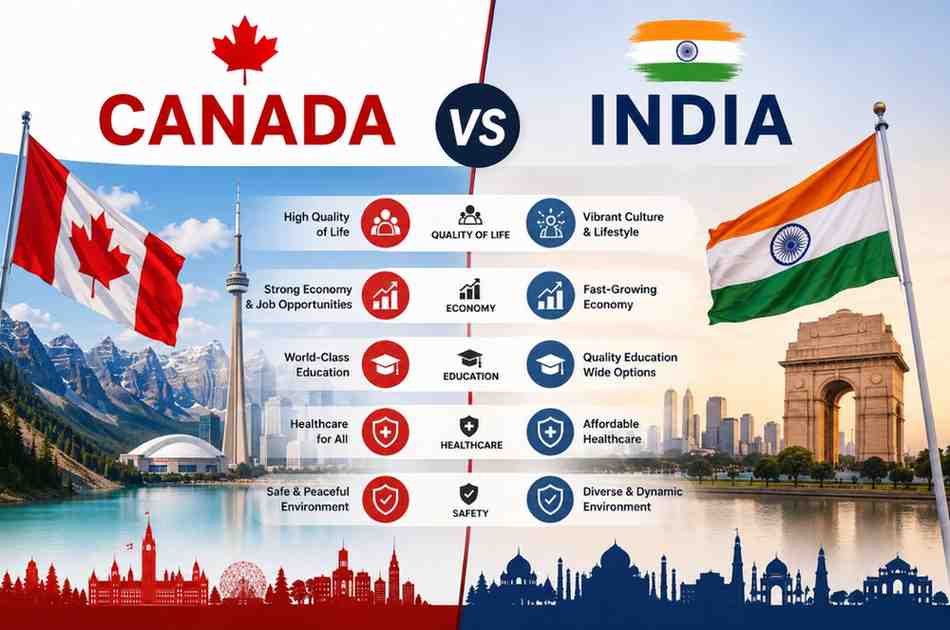
Study in Germany vs Canada: Which Fits Your Priorities
There's no universal winner when you compare Germany vs Canada for Indian students, but the trade-off comes down to two things:
- Germany wins on near-zero public tuition and industry-linked STEM programs
- Canada wins on a clearer, faster PR pipeline and English-only admissions
Choose Germany if minimizing debt is your top priority and you are comfortable using some German in your daily life. Pick Canada if PR speed matters more than upfront cost, despite recent visa-processing changes there. Either way, run both budgets side by side before deciding: the Germany vs Canada for Indian students comparison changes completely once you factor in a scholarship on either side.
3 Takeaways on Study in Germany for Indian Students
- Confirm whether the dMAT requirement affects your bachelor's stream before locking in a Summer Semester 2027 application.
- Budget separately for TUM or Baden-Wurttemberg tuition exceptions if you're shortlisting those universities in Germany.
- Start your APS registration and blocked account paperwork 8-10 months before your intended intake, not after you receive an admission offer.
Get these three right, and the rest of your plan to study in Germany falls into place on schedule.
Verified by: LeapScholar's Germany counseling team, with hands-on experience guiding Indian students through APS, DAAD applications, and student visa filing.
Have questions about studying in Germany? Book a free session with a LeapScholar counselor.
Frequently Asked Questions About Study in Germany for Indian Students
-
Is Germany a good option for Indian students?
Germany offers globally ranked universities, near-zero public tuition, and strong engineering and business job markets, making it one of the most cost-effective options for Indian students weighing study abroad destinations in 2026-27.
-
Is it true you can study in Germany for free?
Public universities charge no tuition for most programs, only a semester fee of EUR 150-430 (Rs.16,338-Rs.46,836). Exceptions exist: TUM charges EUR 4,000-6,000/semester for Master's, and Baden-Württemberg universities charge EUR 1,500/semester for non-EU students.
-
Who needs to take the dMAT exam?
Master's applicants whose bachelor's degree is in engineering, commerce, accounting, finance, economics, business, or management, applying for Summer Semester 2027 or later, must submit a dMAT certificate as part of their APS documentation.
-
How much does it cost to study in Germany for Indian students?
Budget Rs.12,96,584 (EUR 11,904) for the blocked account, Rs.16,338-Rs.46,836 (EUR 150-430) per semester in fees at most public universities, Rs.92,582-Rs.1,30,704 (EUR 850-1,200) monthly for living costs, Rs.15,934 (EUR 146.29) monthly for mandatory health insurance, and Rs.18,000 for the APS certificate, excluding any TUM or Baden-Württemberg tuition exceptions.
-
What are the German student visa requirements for Indian students?
You need a university admission letter, an APS certificate, a blocked account of EUR 11,904, proof of health insurance, and the EUR 75 visa fee, applied for through the Consular Services Portal and a German mission appointment in India.
-
Can I study in Germany without German language skills?
Yes, through English-taught Master's programs, which now number over 1,000. IELTS 6.0-6.5 or equivalent TOEFL scores are usually accepted, though basic German still helps with daily life and part-time work.
-
What is the DAAD scholarship, and am I eligible?
DAAD Germany scholarships fund Master's students at EUR 992 (Rs.1,08,049) monthly and PhD candidates at EUR 1,400 (Rs.1,52,488) monthly from February 2026, plus insurance and travel allowance. Eligibility depends on academic record and, for several programs, prior work experience.
-
Is Ausbildung a better option than a master's degree in Germany?
Ausbildung suits students who want paid, hands-on training and faster entry into the job market, earning at least EUR 724 (Rs.78,858) monthly in year one of 2026, per BIBB. A master's suits those targeting research-heavy or leadership roles requiring an advanced degree.
-
How do I get permanent residency in Germany after studying there?
After your 18-month job-seeker permit converts into employment, most graduates qualify for permanent residency after several years of skilled work and social security contributions, with EU Blue Card holders on a faster track than standard work permit holders.
-
What happens if my German student visa is refused?
Visa refusals most often trace back to incomplete or inconsistent financial documentation. Reapply with a corrected blocked account and income proof rather than assuming your profile itself was rejected.
-
Is Germany safer than other study abroad destinations for Indian students?
Germany has a low crime rate, well-regulated student housing, and an established Indian student community in most university cities, making it comparable to other major European study destinations on safety.
-
Can I study in Germany right after Class 12?
Most Indian Class 12 certificates aren't treated as equivalent to the German Abitur, so you'll typically need a one-year Studienkolleg plus the FSP exam, one completed year at a recognized Indian university, or a valid JEE Advanced result to enter a Bachelor's program directly.
-
How many hours can international students work in Germany?
Non-EU students can work up to 140 full days or 280 half-days per year, roughly 20 hours a week during term time, without needing separate work authorization from the Federal Employment Agency.







Have Questions? Get Guidance to reach your Dream University
Connect with India's finest counsellors and biggest study abroad community.
Get Guidance